
Kristin Scott Thomas reflects on four decades of acting, her leap into directing and why microdramas “are not for me”
One of Europe's most acclaimed actresses, Dame Kristin Scott Thomas has built a remarkable career spanning more than four decades across film, television and theater in both Britain and France. From breakthrough roles in Four Weddings and a Funeral, The English Patient and Gosford Park to her recent success in Slow Horses, she has worked with some of the industry's most celebrated directors while establishing herself as one of the most respected performers of her generation. Speaking at the Monte-Carlo Television Festival after receiving the Crystal Nymph Award, Scott Thomas reflected on her journey from a young actress in Paris to an international star, discussing her directorial debut, the personal family story that inspired it, her parallel careers in French and English productions, the evolution of television drama and the opportunities that continue to inspire her today.
Kristin Scott Thomas
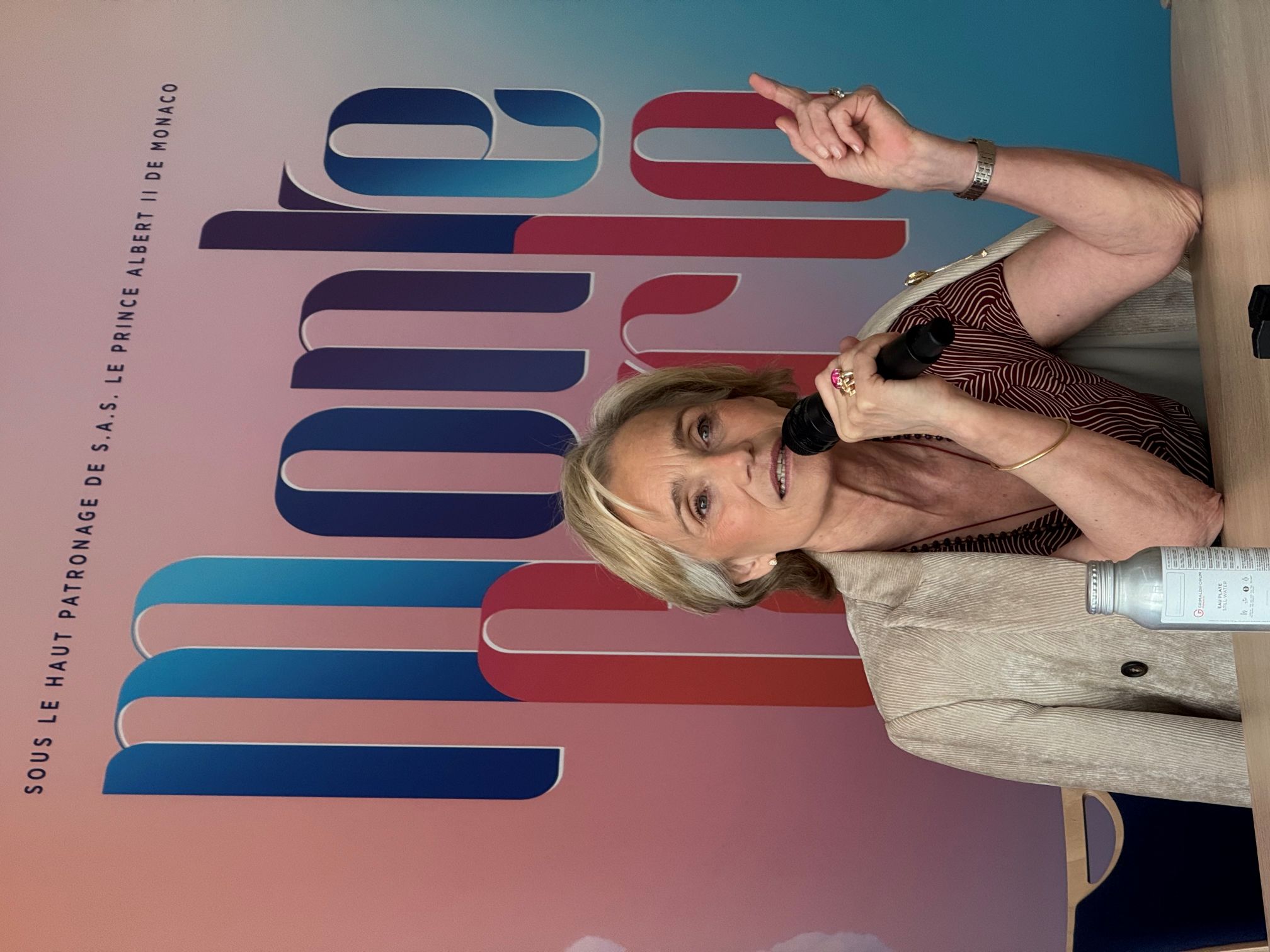
Dame Kristin Scott Thomas opened the second day of the 65th Monte-Carlo Television Festival with a candid and often humorous press conference that ranged from her directorial debut and family history to television's creative renaissance, life between France and Britain, and the emergence of microdramas.
Fresh from receiving the festival’s Crystal Nymph Award, Scott Thomas reflected on a career spanning more than four decades. Looking back, she admitted feeling “quite proud,” recalling that her career began in the South of France in the early 1980s. “My first film was a film with Prince (Under the Cherry Moon, e.n.) at the Victorine studio, which is a few miles from here. And here I am, back again, but for another reason.”
The conversation started with her first feature as writer-director, My Mother’s Wedding. Scott Thomas revealed that directing herself was “very, very, very difficult” and something she “can’t recommend.” Watching playback was particularly challenging. “The only thing you can see is that irritating woman in the background,” she joked.
The film draws heavily on her own childhood. Her father, a Royal Navy pilot, was killed in an accident when she was five years old. Her mother later married another Fleet Air Arm pilot who was also killed in similar circumstances. Scott Thomas explained that she had spent decades seeing the story reduced to a paragraph about her “tragic childhood” in profiles and interviews.
“I wanted to get over it and tell it in a different way,” she said. Rather than making a direct autobiography, she used the experience as the foundation for a story about three women dealing differently with grief while their mother prepares to marry again.
She also recalled how the story first entered the public domain after a French television interview in 1984. Asked what her father thought about her making a movie with Prince, she replied: “Well, actually, he's dead. And then my mother married another one, and he's dead too.”
The actress described the success of Apple TV+’s Slow Horses as “really surprising and sort of astonishing to me” and “deeply satisfying.” She credited the show's quality for drawing her into long-form television. “The writing is exquisite. The whole thing is just a very, very, very high-level package.”
Although she is now closely associated with one of television’s most acclaimed dramas, Scott Thomas reminded journalists that television was actually part of her early career. “I did quite a lot of television when I was very young,” she said, noting that British television in the 1980s and 1990s produced “fantastic television series” that traveled worldwide.
Asked about her first television role, she laughed while recalling a tiny appearance in Maigret. “She was the second blonde hairdresser,” she said, joking that her contribution amounted to little more than saying, “Ah non, je crois qu’il est passé par là.”
Scott Thomas also spoke about her earliest fascination with acting, tracing it back to childhood games of cops and robbers on an airbase in Yorkshire. After being “shot” during one game, she became fascinated by how people behaved. “I started to get really interested in how people behaved and how ladies held their teacups and how people did things.”
Her professional life eventually developed on both sides of the English Channel. After leaving Britain, she moved to France as an au pair and enrolled in drama school in Paris. She described the French capital of the 1980s as “the most exciting period,” recalling that “there was so much energy and money put into culture.”
Asked whether the French or British do anything better, Scott Thomas diplomatically avoided choosing sides, though she offered one clear verdict: “French hairdressers are better.”
She said Brexit highlighted deeper cultural differences. “Everyone in England was obsessed with obeying the rules to the letter,” she observed, while in France people were more inclined to find ways of operating “just within the rules.”
Discussing television drama, Scott Thomas pointed to the French espionage series The Bureau as evidence that world-class television is no longer dominated by English-language productions. “That was extraordinary,” she said, adding that television quality has “just leapt” in recent decades and is “much, much, much better than it was.”
When asked about a role she remains particularly proud of, Scott Thomas highlighted the Romanian-French coproduction An Unforgettable Summer. “It was a really great film which was shot in Romania, in Romanian, and I was so proud of that.”
The actress also addressed a question from TVBIZZ about the rapidly growing microdrama sector. While intrigued by the phenomenon, she clearly distinguished it from traditional television and film.
“I find that completely riveting. But I don’t want to be in one,” she said. Comparing microdramas to fast food, she described them as “chips from a fast food place” and argued that they are “not at all in the same category as film or TV. It’s something else entirely.”
However, she acknowledged their potential value as a creative training ground. “I think it’s a really great training ground for writers,” she said, before concluding simply: “Not for me.”
Throughout the discussion, Scott Thomas repeatedly returned to the idea that her career is entering an exciting new chapter. While continuing to act in high-profile productions such as Slow Horses, she is increasingly focused on writing and directing.
“I am so excited about what’s happening now for me,” she said. “Writing, directing, these things that are starting to open up for me. That is a real thrill.”
More than forty years after arriving on the French Riviera as a young actress making her first film with Prince, Kristin Scott Thomas returned to Monte-Carlo not only as one of Europe’s most celebrated performers, but as a filmmaker embarking on a new creative journey.
Fresh from receiving the festival’s Crystal Nymph Award, Scott Thomas reflected on a career spanning more than four decades. Looking back, she admitted feeling “quite proud,” recalling that her career began in the South of France in the early 1980s. “My first film was a film with Prince (Under the Cherry Moon, e.n.) at the Victorine studio, which is a few miles from here. And here I am, back again, but for another reason.”
The conversation started with her first feature as writer-director, My Mother’s Wedding. Scott Thomas revealed that directing herself was “very, very, very difficult” and something she “can’t recommend.” Watching playback was particularly challenging. “The only thing you can see is that irritating woman in the background,” she joked.
The film draws heavily on her own childhood. Her father, a Royal Navy pilot, was killed in an accident when she was five years old. Her mother later married another Fleet Air Arm pilot who was also killed in similar circumstances. Scott Thomas explained that she had spent decades seeing the story reduced to a paragraph about her “tragic childhood” in profiles and interviews.
“I wanted to get over it and tell it in a different way,” she said. Rather than making a direct autobiography, she used the experience as the foundation for a story about three women dealing differently with grief while their mother prepares to marry again.
She also recalled how the story first entered the public domain after a French television interview in 1984. Asked what her father thought about her making a movie with Prince, she replied: “Well, actually, he's dead. And then my mother married another one, and he's dead too.”
The actress described the success of Apple TV+’s Slow Horses as “really surprising and sort of astonishing to me” and “deeply satisfying.” She credited the show's quality for drawing her into long-form television. “The writing is exquisite. The whole thing is just a very, very, very high-level package.”
Although she is now closely associated with one of television’s most acclaimed dramas, Scott Thomas reminded journalists that television was actually part of her early career. “I did quite a lot of television when I was very young,” she said, noting that British television in the 1980s and 1990s produced “fantastic television series” that traveled worldwide.
Asked about her first television role, she laughed while recalling a tiny appearance in Maigret. “She was the second blonde hairdresser,” she said, joking that her contribution amounted to little more than saying, “Ah non, je crois qu’il est passé par là.”
Scott Thomas also spoke about her earliest fascination with acting, tracing it back to childhood games of cops and robbers on an airbase in Yorkshire. After being “shot” during one game, she became fascinated by how people behaved. “I started to get really interested in how people behaved and how ladies held their teacups and how people did things.”
Her professional life eventually developed on both sides of the English Channel. After leaving Britain, she moved to France as an au pair and enrolled in drama school in Paris. She described the French capital of the 1980s as “the most exciting period,” recalling that “there was so much energy and money put into culture.”
Asked whether the French or British do anything better, Scott Thomas diplomatically avoided choosing sides, though she offered one clear verdict: “French hairdressers are better.”
She said Brexit highlighted deeper cultural differences. “Everyone in England was obsessed with obeying the rules to the letter,” she observed, while in France people were more inclined to find ways of operating “just within the rules.”
Discussing television drama, Scott Thomas pointed to the French espionage series The Bureau as evidence that world-class television is no longer dominated by English-language productions. “That was extraordinary,” she said, adding that television quality has “just leapt” in recent decades and is “much, much, much better than it was.”
When asked about a role she remains particularly proud of, Scott Thomas highlighted the Romanian-French coproduction An Unforgettable Summer. “It was a really great film which was shot in Romania, in Romanian, and I was so proud of that.”
The actress also addressed a question from TVBIZZ about the rapidly growing microdrama sector. While intrigued by the phenomenon, she clearly distinguished it from traditional television and film.
“I find that completely riveting. But I don’t want to be in one,” she said. Comparing microdramas to fast food, she described them as “chips from a fast food place” and argued that they are “not at all in the same category as film or TV. It’s something else entirely.”
However, she acknowledged their potential value as a creative training ground. “I think it’s a really great training ground for writers,” she said, before concluding simply: “Not for me.”
Throughout the discussion, Scott Thomas repeatedly returned to the idea that her career is entering an exciting new chapter. While continuing to act in high-profile productions such as Slow Horses, she is increasingly focused on writing and directing.
“I am so excited about what’s happening now for me,” she said. “Writing, directing, these things that are starting to open up for me. That is a real thrill.”
More than forty years after arriving on the French Riviera as a young actress making her first film with Prince, Kristin Scott Thomas returned to Monte-Carlo not only as one of Europe’s most celebrated performers, but as a filmmaker embarking on a new creative journey.